Understanding Why Dogs Yawn – Hint…It's Not ALWAYS Because They're Tired!
There is no doubt that a dog is really man's best friend. These
adorable furry creatures are loving, loyal and never cease to provide
their human family with endless joy and companionship. The pet will
stick with you through thick and thin. Dogs are known to ape what their
masters do. It is really quite amusing to see that a dog will empathize
with the master even with yawning. A master coming in from the office
very tired will yawn; the dog can be seen yawning too.
A misconception that dogs yawn because they're tired, as we would do,
can actually lead to problematic encounters. Because a dog yawn can
actually be a precursor to something much more serious in the way of anxiety, fear and even a bite.
People yawn when they are bored, sleepy and fatigued. Interestingly,
foetuses that are 12 weeks old are seen yawning. Yawning in dogs
however, has no definitive reason. When we see our pets yawn we take it
for granted that their reason for yawning is pretty much the same as the
reason why we do.
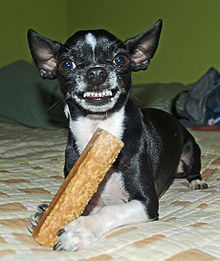
Scientists have theorized that dogs yawn when they are bored.
If you are an observant pet owner you will see at once that the pet is
bored. Most often the dog will look at you with imploring eyes, yawn and
then flop to the ground. The dog is telling you "come on, play with me"
A yawning dog with a tense and rigidly held body is a sign that the
dog is nervous. This reaction is often seen in obedience classes where
the dog is pressured. The dog wants to please the master but does not
know how. If you are training your dog and you noticed him yawning, you
better let up. Proceeding with the training will not have positive
results anyway. Let the dog rest for a while and encourage with verbal
praises.
Excitement is another reason why dogs yawn. Dogs in agility
competitions are often noted yawning. This is the dogs way of coping
with the excitement. A dog in the starting line is ready and raring to
go to scale the obstacle. By yawning, the dog is preparing its body for
the action. The deep breaths fill the lungs and boost the flow of oxygen
to the brain. This also increases the heart rate. Really quite amazing
how the dog will cope with situations such as this!
Commonly, dogs yawn because they are tired and sleepy. Yawning is
precursor to sleeping. Dogs like cats sleep a lot so it will not be an
extraordinary thing to see your pet yawning.
Studies have proven that yawning is contagious. If you yawn, somebody
else will yawn too. Dog handlers have used the fact that yawning can
energize, calm and relax a dog. By yawning, they can induce the pet to
yawn too.
Find out more about why dogs yawn and many other interesting
questions about dogs at Sarah's Dogs. Sarah's Dogs has profiles of most
common and many rare breeds as well as answers to common questions on
dog behaviour.
Understanding dog yawns can also be crucial in potentially avoiding being attacked by a dog.
As yawning can be such a visual display of stress or anxiety, if you
happen to notice a dog is constantly yawning when you approach it or
even petting it (especially on the head), this could be a stress signal
coming from the dog.
A guide to canine mouth signals:
1. Mouth relaxed and slightly open, tongue may be slightly
visible or even slightly draped over the lower teeth: This is the dog
equivalent of the human smile. It means "I am happy and relaxed."
2. Yawn: While it is usually interpreted by humans as meaning
fatigue or boredom, it can actually be a stress-related signal, best
interpreted as "I am tense or anxious."
3. Lips curled to expose some teeth, mouth still mostly closed: "You are annoying me!" This is the first sign of menace or threat.
4. Lips curled up to show major teeth, some wrinkling of the
area above the nose, mouth partly open: "If you do something that I
might interpret as a threat, I may bite." This is the next stage of
threat but may also indicate fearfulness. Pressing a dog at this stage
may lead to an aggressive attack.
5. Lips curled up to expose not only all of the teeth but also the gums above the front teeth,
visible wrinkles above the nose: "Back off!" This is the full threat
display that indicates a dog is ready to release a violent attack. If
you are ever confronted with this display, you should not turn and run:
the level of arousal is so high that your movement will probably produce
a pursuit-and-attack response. Instead, cast your gaze slightly down (a
slightly submissive eye position), open your mouth a bit (a bit of a
counter-threat), and back off slowly.
Source - mydogmagazine.com
Article by K9 Magazine
Canine Shop is an online only store specialising in dog products. Here on our Canine Shop blog you will find interesting articles, ideas, what other dog lovers out there are doing, and of course our Canine Shop updates should you wish to want to have a browse around our shop.
Sunday, 13 November 2011
Monday, 7 November 2011
How Can I Stop My Dog Begging?
Training Your Dog Not To Beg
A common problem, dog begging. Or is it? A problem, that is? A begging dog is cute, no? A dog who begs for their supper, tidbits or ‘a bit of what you’re having’ is all part of the canine charm, is it not?Ultimately, that’s entirely up to you. You see, the begging ‘problem’ is only a problem when it becomes a problem. If you follow me. Dogs who learn to beg for food often fall in to that horrible grey area of learning a behaviour/habit that is, as far as their owners go, OK sometimes and totally not cool at others. Hmmm. This is no good. Not really. Dogs are far happier if they understand that a behaviour is either OK, all of the time, or not OK, all of the time. Begging is one of these behaviours.
Learning to beg or steal food is the easiest of all life’s lessons for a puppy. The art is most often taught by the pup’s owners. In some cases, it is learned when food is accidentally dropped on the floor, or left unattended where the puppy can get at it.
Human taste discrimination is so crude when compared to the dog’s that many owners fail to appreciate the mistake of giving their pups little treats of the family food fare. Many times it only takes one taste of highly spiced table food to ruin a puppy’s appreciation for its less-seasoned commercial diet. The result can be a pup that turns up its nose at dog food and becomes a roaring menace around the dinner table.
Training a Dog to Stop Begging
The training
method of extinguishing begging takes time. The time it takes depends
on the duration of the habit, the pup’s tenacity, and the consistency of
its owners in carrying out corrective procedures. It requires that
absolutely no attention be given the begging pup, regardless of its
antics in trying to gain tidbits.In the case of food stealing, the training method of extinguishing the behaviour requires even more careful control of the environment, especially when young children are involved. They usually love to share their goodies with their pets, but it is impractical to explain the cause-effect relationship to such youngsters when they complain that “Sparky jumped up and stole my ice cream cone!” Children also tend to leave articles of food around on low tables and chairs, an irresistible temptation for most puppies.
Help! How Do I Stop My Dog Stealing Food?
To eliminate stealing, whether it is overt (taking food from
children) or covert (pilfering the thawing dinner steak), it is
necessary to initiate a program of at least 4 weeks, during which no
food is ever placed within the pup’s reach. It goes without saying that
no tidbits should be given during this period.Remedies that often fail include lacing some food with pepper or ammonia, saying “No-no” while tempting the pup, and physically punishing the animal when it approaches the family’s food. These fail because they require the presence of some agent other than the food, either the aversive-tasting element or the owner. When these elements are not present, the pup is rarely discouraged from stealing the food. It learns to discriminate between treated and untreated morsels, and to avoid food in the owner’s presence.
Begging food from the dinner table is one of the easiest things to teach a dog, and also one of the hardest habits to break. Your pet’s training to beg begins when he is a young, adorable puppy. It does not take too many repetitions before he learns that he gets fed from the table by begging. Then he sits by your chair while you are eating and stares at you. Occasionally he’ll get up on his hind legs and paw you, or he’ll nudge your arm and remind you that he is waiting. And he drools, that’s the worst part. He looks as though you never feed him.
If you don’t have this problem, prevention is quite simple. Don’t start giving your dog food from the table. If you must give your dog table scraps, give them in moderation and in his own dish after you have finished eating or, better yet, with his regular meal. Once you have a dog that begs, it becomes a self-perpetuating problem. Begging is rewarded with food.
Chances are, if you have this problem, you’ve tried to stop his begging, you’ve yelled at him when he begs, pushed him away, and even gotten really angry, but he just gets more persistent. So you’ve had to give him something to be able to eat in peace. What you have done is to reward his persistence. Each time you have tried holding out longer, but have ultimately given in, you have further trained him that no matter how far away the rainbow looks, there is a pot of gold at the end if he simply waits.
When you are tired of this behaviour and want to end it, when you get to the point that you can’t stand the drooling, the whining, the pawing and the sad eyes staring at you, then you have to steel yourself for the cure. Using the positive approach, give him the command “Down” and have him do a long “Down” by your chair during dinner. Be prepared for many interruptions initially, while you reinforce his “Down.” Each time he gets up, repeat the command and replace it if necessary so that he remains down during your dinner.
With a truly persistent begger, your first week of dinners may be quite a trial. Some dogs bark repeatedly and go through all manner of random actions to try to get you to feed them from the table. But once you have begun the training, stick with it. If you give in at any time, no matter how small the tidbit you sneak him, not only have you lost that battle, you may very well have lost the entire war. If you have made up your mind that you don’t want begging, then it’s just a matter of time before you have your dog resigned to the fact that the party is over, at least at the dinner table.
When your dog is steady enough to do the long “Down” away from your side during dinner, then establish his place where he stays while you eat. He should be put in his place every evening while you are eating, and praised when you release him at the end of the meal. It won’t be too long before you will be eating dinner in the company of a well-trained, well- behaved dog lying quietly in the corner.
The Hardline Approach on Dog Begging – Why You Should Never Let Your Dog Beg For Food & Attention
Unless they are trained not to do so, most dogs will form the natural
habit of begging for both attention and food. Some dog owners except
this behaviour and think it’s cute, but most people get annoyed very
quickly when their dog starts to beg every time he wants love,
attention, and especially when he smells something tasty cooking in the
house.What is wrong with begging you might ask?
For starters, begging is another form of demanding and it gives your dog an aspect of control within the family “pack”. I describe your family as a pack because that is exactly how your dog sees it. Anyways, while it seems adorable when Sparky rolls over on his back expecting a belly rub every time you enter the room, or just sits all teary-eyed staring straight at your plate of food when you’re eating dinner, this behaviour has the possibility to gain momentum and become aggressive.
Just how aggressive can a dog possibly become?
If you do not think that your dog could ever possibly bite your hand because he expects you to give him food every time he begs, think again. For years a friend of mine would hand feed his puppy pieces of food at any time of the day he was eating. If it were breakfast, his dog would get a two pieces of bacon. At lunch time my friend would hand feed his dog a few bites of his sandwich. The same went for dinner.
After some time, his dog matured and grew bigger, and my friend did not realize that he was reinforcing a dominant leadership
role into his dog every time he gave in to begging. Once he decided to
change this behaviour with his dog, he learned quickly just how
dangerous the situation was. At one of his meals, my friend absolutely
refused to feed his dog anything and the begging and crying turned into
aggression and barking. Then without notice, his dog leaped up onto his
plate and snapped at the food, taking a little bit of my friends flesh
with it.
The above example may seem a bit extreme and you still probably could never imagine you’re adorable dog biting you in the attempt to get food that he was expecting. However, the problem is real and you must start early in your puppy’s life with instilling the rules when it comes to begging.
During your meals, you need to train your dog to sit and stay in a specific area when the family is eating. This may take some time but eventually he will remain in a sit position until after your dinner is over and then of course you should praise his actions by offering him up a nice hot meal that he can eat in his own food bowl, and only after everybody else is finished eating.
Article posted by K9 Magazine filed in: Dog Training
Thursday, 3 November 2011
Dog ideas? The Thundershirt
Don't know what product to buy? Want to choose a gift for someone but want some suggestions? Just want to browse to see what's available?
Our Canine Shop has a shop by activity category to help you find products. For further information on how to use our webstore please refer to our blog page Canine Shop Launch.
By browsing by activity we can suggest and introduce to you products that you may or may not know existed.
In October, to promote our launch let us introduce to you a new product on our shelves - the Thundershirt.
The Thundershirt is a non invasive tool designed to aid dog anxiety, so if you dog is jumpy, restless or anxious, this maybe the answer for you.
Dog anxiety is more common than you think. Anything from loud sounds, travelling in a vehicle to sounds and actions in everyday life can upset your dog causing him/her to bark, shake and/or even fidget through pacing or just running around aimlessly. Perhaps you have even witnessed more types of symptoms yourself.
Instead of the use of medication, company Thundershirt have come up with an alternative solution to help your dog tackle these anxieties.
By browsing by activity we can suggest and introduce to you products that you may or may not know existed.
In October, to promote our launch let us introduce to you a new product on our shelves - the Thundershirt.
The Thundershirt is a non invasive tool designed to aid dog anxiety, so if you dog is jumpy, restless or anxious, this maybe the answer for you.
Dog anxiety is more common than you think. Anything from loud sounds, travelling in a vehicle to sounds and actions in everyday life can upset your dog causing him/her to bark, shake and/or even fidget through pacing or just running around aimlessly. Perhaps you have even witnessed more types of symptoms yourself.
Instead of the use of medication, company Thundershirt have come up with an alternative solution to help your dog tackle these anxieties.
Subscribe to:
Posts (Atom)